Click to move up one level  
manual products motor driven stages downloads in stock itmes FAQs site map about velmex
  HOME > MOTOR DRIVEN HOME > CONTROLLERS - STEPPER MOTOR > VP9000 1 (800) 642-6446 or 1 (585) 657-6151 (in NYS)
  enter search word
 
 
  Examples
  UniSlide Assemblies
  BiSlide vs. UniSlide
  More about BiSlide
  Send Me Your Catalogs
  Load Capacity
  Rotary Tables

Controller No Longer Available. See VXM controller

Features Specifications Command Summary

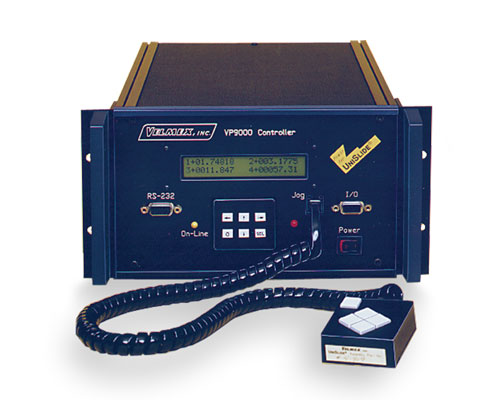
The VP9000 is a complete, powerful stepping motor controller/driver, capable of running up to four motors, in one compact package. The VP9000 is fully front panel and RS-232 programmable. Commands and data are entered either through the RS-232 interface or selected with the front panel keyboard. Motor position(s), setup parameters, and menus are viewed on the front panel display. 31 programs (over 1900 moves) can be entered into nonvolatile memory. An optional encoder interface is available for automatic motor stall detection.

Features

  • Completely wired and tested for direct connection to UniSlide motors/Assemblies.
  • Linear type motor and logic power supplies provide low Electromagnetic Interference (EMI).
  • Motor position can be read while motor is in motion.
  • Automatic Power Down reduces power consumption by de-energizing the motors when at a standstill. Motor 1 can be set to stay energized when at a standstill.
  • A Digitizing function can be utilized with the front panel display, or with a host computer or terminal.
  • A Jog Controller (included) allows motors to be jogged manually one step or slewed up to full speed.
  • Front Panel Readouts can be set to display motor position in "real" units for various Lead Screw pitches and Rotary Table gear ratios.
  • "Friendly" error messages displayed on front panel simplify troubleshooting.
  • Terminal/Editor, Diagnostic and BASIC, C, and PASCAL Example Programs for DOS PCs on diskette are included.
  • The VP9000 can run in an interactive or stand-alone mode.
  • Acceleration/Deceleration is programmable from 1,000 to 127,000 steps/sec2 in 1,000 step/sec2 increments.
  • Speed is programmable from 1 step/ 2 sec to 8000 steps/sec in 1 step/sec increments.
  • Incremental and Absolute Index distances are programmable from ±1 to ±16,777,215 steps.
  • Programmable Home to Limit and Zero Position commands.
  • The VP9000 stores thirty-one different programs (total of 1984 different moves), or an optional sixty-two program version.
  • Jump-to a different program and Jump-to-and-return commands allow programs to be extensions and subroutines to other programs.
  • Nine powerful Loop Commands provide from one to continuous repeat operations, performing simple functions like auto-reverse to raster scans and other complex X,Y matrix patterns.
  • Programmable pauses from 100 milliseconds to 109 minutes in 100 millisecond intervals, and 0.1 milliseconds to 6.5535 seconds in 0.1 millisecond intervals.
  • Two User Outputs can be programmed to turn On and Off an external solid state relay, or interface to other logic level devices.
  • Two User Inputs can be utilized in a program as WAITs for an external logic "low" level, external switch, or relay closure.
  • Special Inputs provide interruption of WAIT or motion commands. An interrupt will decelerate a running motor to a stop, or terminate a WAIT command and transfer control to a user specific program.
  • A user programmable counter can totalize over four billion counts and display total on the front panel.
  • The VP9000 can be programmed to send a pulse or character at preset distances without stopping or slowing the motor. Up to 6 speeds can be preset to change "on the fly".
  • Backlash Compensation can be set to automatically finish every index approaching from the positive direction.
  • Single Step mode is provided for debugging a program or as a controlled interrupt.
  • The VP9000 can be polled for its status at any time; additionally a prompt ("^") is automatically sent to the host when a program has finished.
  • Multiple controllers can be "daisy-chained" together, allowing the host to address each one from just one serial port.
  • Limit Switches for CW and CCW directions are provided with plug-in connection to UniSlide limit switch assemblies. Limits can be used for "homing"; unused limit switch inputs can be software disabled.
  • The VP9000 can be set to signal the host when a limit switch has been encountered.
  • Extensive self testing built in.
  • Compact Enclosure, rack mountable, with no fans or vent openings.
  • A twelve-foot serial communication cable, and 25 to 9 pin adapter for PCs comes standard.
  • 2 year Limited Warranty.

Specifications

Functional

  • Packaged Controller/Driver, 400 steps per revolution (0.9o step angle) resolution. Operates one to four (dependent on model) motors, one-at-a-time. Bi-level motor drives, settable holding torque for motor one. Interactive limit switch inputs (TTL), (CW and CCW for each axis).
  • User input 1 active high (0V to +3V min., -25V to +25V max.), Input 2 is TTL active low, and two user outputs (0 or +5V, 10 mA sinking and 3 mA sourcing capability).
  • Wide viewing angle, 2 line x 24 character, backlit, super-twist LCD readout for motor position display and data selection.
  • Six key calculator quality keyboard for cursor control, display selection, and 0 entry.
  • Front panel programmable or through a full-duplex three wire RS-232-C; 300,1200,4800,9600 Baud (settable), 7 Data bits, Even parity, 2 Stop bits, ASCII.
  • User available NVRAM for program storage is 7936 bytes.
  • Remote Run, Reset, Two Interrupt input.
  • Inputs to count quadrature converted pulses from multiplexed encoder.
  • Ten-foot motor and limit switch cables with connectors.

Electrical Requirements

  • 90-130 VAC, 50/60 Hz operation standard.
  • 190-260 VAC, 50/60 Hz operation is optional.

Motor Compatibility

  • American Precision: 23D-6108A, 23D-6209A, 23D-6309A, 34D-9109A, 34D-9209A, 34D-9311A
  • Bodine Electric: 2430, 2530, 2431, 2531, 2411, 2511, 2433, 2533, 2434, 2534, 2435, 2535
  • Superior Electric: MO61-LS08, MO62-LS09, MO63-LS09, MO91-FD09, MO92-FD09, MO93-FD11
  • Vexta: PX245-01, PX245M-01, PX245-02, PX245M-02, PK245-01, PK245M-01
  • Other motors on request

Physical

  • Weight: 22 lbs. (10 kg)
  • Height: 5.2 inches (13.2 cm)
  • Width (without handles): 8.5 inches (21.6 cm)
  • Depth (without handles): 14.3 inches (36.3 cm)

Environmental

  • 35o to 95o F ( 2o to 35o C ) Convection cooled

Models

Cat # Model # Version
4-911 VP9001 One motor
4-912 VP9002 Two motor, one-at-a-time.
4-913 VP9003 Three motor, one-at-a-time.
4-914 VP9004 Four motor, one-at-a-time.

Options

  • Cat. # 4-918, 19" Rack Mount Extension Plates
  • Cat. # 4-919, Encoder Interface Module for 1-4 motors


VP9000 Command Summary

Motion Commands
ImMx Set steps to incremental Index motor CW (positive), m=motor# (1,2,3,4), x=1 to 16,777,215
ImM-x Set steps to incremental Index motor CCW (negative), m= motor# (1,2,3,4), x=1 to 16,777,215
IAmMx

Set Absolute Index distance, m=motor# (1,2,3,4), x= ±1 to ±16,777,215 steps

IAmM0 Index motor to Absolute zero position, m=motor# (1,2,3,4)
IAmM-0 Zero motor position for motor# m, m= 1,2,3,4
ImM0 Index motor until positive limit is encountered, m=motor# (1,2,3,4)
ImM-0 Index motor until negative limit is encountered, m=motor# (1,2,3,4)
SmMx Set Speed of motor (70% of power applied to motor), m=motor# (1,2,3,4), x=0 to 8000 steps/sec. 0 being 1 step/ 2 sec.
SAmMx Set Speed of motor and Ascend to 100% power, m= motor# (1,2,3,4), x=0 to 8000 steps/sec. 0 being 1 step/ 2 sec.
AmMx Acceleration/deceleration, m= motor# (1,2,3,4), x=1 to 127; 1 is 1000 steps/sec2, 2 is 2000 steps/sec2, 127 is 127000 steps/sec2, etc.

Looping Commands
L0 Loop continually from the beginning or Loop-to-marker of the current program
LM0 Sets the Loop-to-marker at the current location in the program
LM-0 Resets the Loop-to-marker to the beginning of the current program
Lx Loop from beginning or Loop-to-marker x-1 times (x=2 to 65,535), when the loop reaches its last count the non-loop command directly preceding will be ignored
L-x Loop from beginning or Loop-to-marker x-1 times, alternating direction of motor 1, when the loop reaches its last count the non-loop command directly preceding will be ignored
LAx Loop Always from beginning or Loop-to-marker x-1 times (x=2 to 65,535)
LA-x Loop Always from beginning or Loop-to-marker x-1 times, alternating direction of motor 1
LM-2 Loop once from beginning or Loop-to-marker reversing index direction of motor 2
LM-3 Loop once from beginning or Loop-to-marker reversing index direction of motor 1 and motor 2

Miscellaneous Commands
Px Pause x tenths of a second (x=0 to 65,535, 10 msec pause when x=0)
PAx Pause x tenths of a second Altering output 1 high for duration of the pause (x=0 to 65,535, 10 msec pause when x=0)
P-x Pause x tenths of a millisecond (x=0 to 65,535)
PA-x Pause x tenths of a millisecond Altering output 1 high for duration of the pause (x=0 to 65,535)
Bx Backlash compensation, compensation on when x=1, off when x=0
Ox Indicate limit switch Over-travel to host, off when x=0, VP9000 sends "O" when x=1 and a limit switch is encountered
PMx Select Program number x, x= 0 to 30
PM-x Select and clear all commands from Program number x, x= 0 to 30
PM Request the number of the current Program
Jx Jump to the beginning of program number x, x= 0
JMx Jump to the beginning of program number x and come back for More after program x ends, x= 0 to 30

User I/O Commands
U0 Wait for a "high" on user input 1
U1 Wait for a high on user input 1, holding user output 1 high while waiting
U2 Enable Jog mode while waiting for an input
U3 Disable Jog mode while waiting for an input
U4 User output 1 "low" (reset state)
U5 User output 1 high
U6 Send "W" to host and wait for a "G" to continue
U7 Start of Continuous Index with pulse on output 2
U8 Start of Continuous Index sending "@" to the host
U9 End of Continuous Index
U10 Wait for a low on input 2
U11 Wait for a low on input 2, holding user output 2 high while waiting
U12 Wait for a keyboard key to jump to a program or continue: ç key to jump to program #21, è key to jump to program #22, ê key to jump to program #23, é key to jump to program #24, 0 or SEL key to proceed in current program
U13 Wait for a button on Remote Control to jump to a program or continue: 1- key to jump to program #25, 1+ key to jump to program #26, 2- key to jump to program #27, 2+ key to jump to program #28, key to proceed in current program
U14 User output 2 low (reset state)
U15 User output 2 high
U16 Wait for ç key to be pressed on front panel keyboard
U17 Wait for è key to be pressed on front panel keyboard
U22 Wait for a keyboard key to jump to a program and come back, or continue: ç key to jump to program #21 and come back, key è to jump to program #22 and come back, key ê to jump to program #23 and come back, key é to jump to program #24 and come back, 0 or SEL key to proceed in current program
U23 Wait for a button on Remote Control to jump to a program and come back, or continue: 1- key to jump to program #25 and come back, 1+ key to jump to program #26 and come back, 2- key to jump to program #27 and come back, 2+ key to jump to program #28 and come back,  key to proceed in current program
U30 Wait for a high to low transition on user input 1
U31 Wait for a high to low transition on user input 1, holding user output 1 high while waiting
U32 Wait for 1- button to be pressed on Remote Control
U33 Wait for 1+ button to be pressed on Remote Control
U40 Wait for a low to high transition on input 2
U41 Wait for a low to high transition on input 2, holding user output 2 high while waiting
U50 Wait for a high and low on user input 1 with debouncing for a mechanical push-button switch
U51 Wait for a high and low on user input 1 with debouncing for a mechanical push-button switch, holding user output 1 high while waiting
U60 Wait for a low and high on user input 2 with debouncing for a mechanical push-button switch
U61 Wait for a low and high on user input 2 with debouncing for a mechanical push-button switch, holding user output 2 high while waiting
U70 Zero counts in user programmable counter
U71 Display user programmable counts "on"
U72 Display user programmable counts "off"
U73 Increment user programmable counter by one
U90 Wait for Run input

Single Character Commands
Q Quit On-Line mode (return to Jog/slew mode)
R Run currently selected program
N Null (zero) motors 1,2,3,4 absolute position registers
K Kill operation in progress and reset user outputs
V Verify Controller’s status, VP9000 sends "B" to host if busy, "R" if ready, or "J" if in the Jog/slew mode
C Clear all commands from currently selected program
D Decelerate to a stop (interrupts current index in progress)
E Enable On-Line mode with echo "on"
F Enable On-Line mode with echo "oFF"
G Same as "F" except <Cr> is added as termination character
H Put Controller on Hold (single step mode)
X Send position of motor 1 to host
Y Send position of motor 2 to host
Z Send position of motor 3 to host
T Send position of motor 4 to host
M Request Memory available for currently selected program
# Request the number of the currently selected motor
% Requests encoder/motor status from last index, VP9000 sends: = when motor counts and encoder counts are equal, < when encoder counts are less than motor counts (motor stall), > when encoder counts are greater than motor counts (motor overshoot)
{x} Send commands to the next VP9000 in the "chain", x are any of the previous commands
& Enable multiple VP9000s that are daisy chained
* Request position when last motor was interrupted with a "D" command or user Input 4


<>